
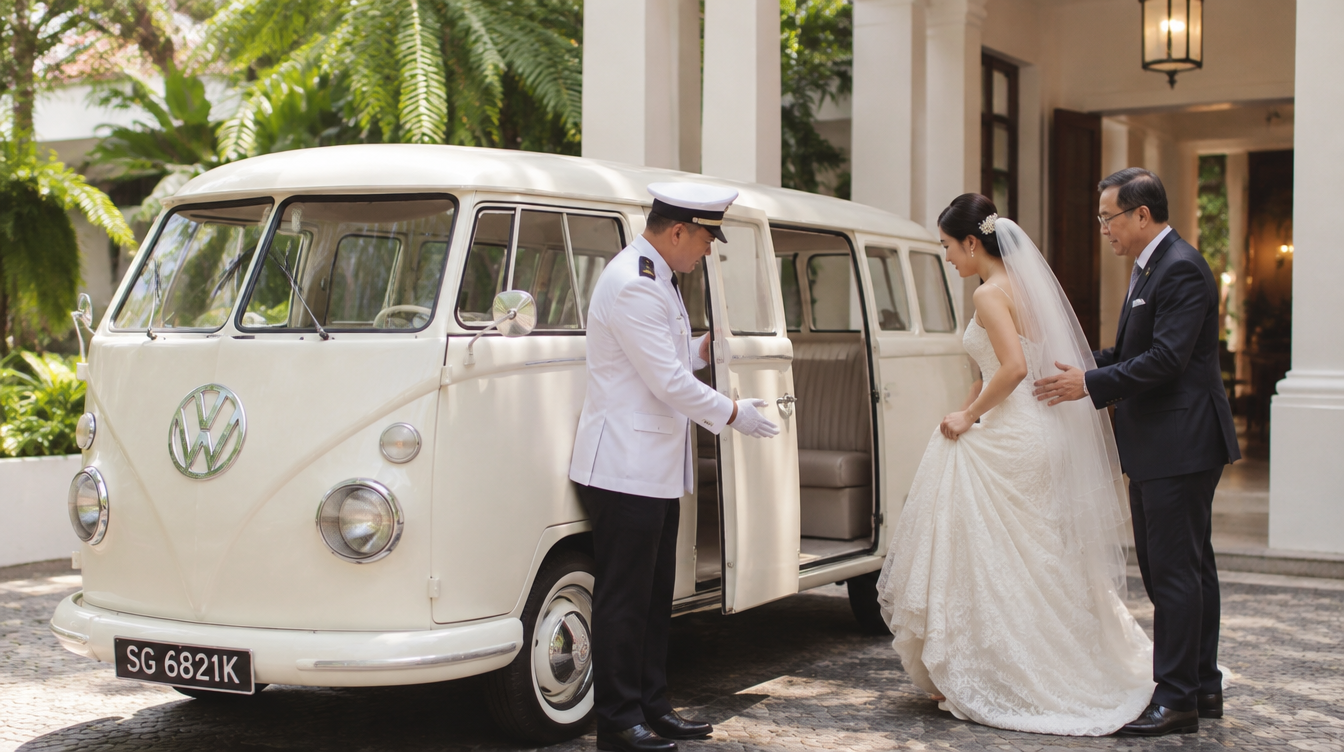
A bride is fully dressed, her father is waiting by the door in his best suit, and three cars are idling in the driveway. Nobody has actually decided who climbs into which one first. It sounds like a minor detail next to the ceremony itself, yet it is one of the small logistics questions that catches more couples off guard than almost anything else on the morning schedule.
Most of the planning energy around a wedding car goes into choosing the model, confirming the plate number and working out the route. Who actually sits inside it, and in what order the cars pull away, tends to get decided on the spot by whoever is standing closest to the door. A little wedding car seating etiquette, worked out in advance, saves that decision from falling to chance.
Why Seating Order Deserves a Plan
Seating order shapes two things at once: the photographs and the family expectations sitting quietly underneath them. A photographer who knows the bride is arriving with her father, not her mother, can position the whole shot before the car door even opens. A chauffeur who has been briefed in advance can open the right door for the right person without an awkward pause while everyone works it out on the kerb. None of this needs to be complicated, but it does need to be decided before the morning gets busy.
Before the Ceremony: Who Travels With the Bride
The most common convention in Singapore has the bride travelling to the ceremony with her father or another senior guardian, while the groom arrives separately. Keeping the two apart until the ceremony itself preserves the moment many couples still want: the first proper look at each other happening at the altar or during the solemnisation, not in a shared back seat beforehand.
Some brides prefer company instead of a solo escort, and travel instead with her mother, a sister, or two bridesmaids if the car has room. A gown with a long train or a wide skirt often decides this for her in practice, since a car that fits one person comfortably in full dress may feel cramped with a second passenger beside her. The groom’s own car is usually simpler to plan, carrying him with his best man or his parents, and rarely needs the same careful thought.
It helps to tell both the chauffeur and the photographer the plan a few days ahead, not on the morning itself. A chauffeur who already knows the bride is travelling with her father can have the door open and ready the moment they step outside, and a photographer who knows the arrival order can find the right angle before the car has even stopped.
After the Ceremony: The Couple Travels Together
Once the vows are exchanged, the seating question usually settles itself. This is the first ride the couple takes together as a married pair, and for most couples it becomes one of the day’s quieter, more photographed moments: the chauffeur holding the door, the couple settling in side by side, the car pulling away from well-wishers still waving on the steps.
A few couples choose to let the photographer or videographer travel in a trailing car instead of asking them to squeeze in alongside the newlyweds, which keeps that first few minutes together a little more private while still capturing the departure itself from outside.
When There Is More Than One Car
Bigger bridal parties usually mean more than one vehicle, and a simple running order keeps everyone moving without a scramble at the kerb. A typical sequence for a four-car arrangement looks something like this:
- The bridal car, carrying the bride and her escort before the ceremony, or the couple together afterwards
- The parents’ car, following close behind so they reach the venue in time for the formal family photographs
- The bridal party car, seating the bridesmaids and groomsmen as a group
- A trailing car for grandparents or elderly relatives, who often appreciate a slightly slower, steadier pace than the rest of the convoy
If you have already worked out your wedding cars for your bridal party, it is simplest to slot the seating decisions into that same running order rather than treating them as a separate conversation closer to the day.
Cultural Customs Add Their Own Order
Several of Singapore’s wedding traditions already carry their own seating and boarding conventions, built up over generations, not decided fresh for each couple. A Chinese tea ceremony morning often moves the bridal car between two households in a set sequence, with parents and elders collected in an order that reflects seniority within the family, a pattern documented among Singapore’s recognised Chinese wedding customs. Malay and Indian ceremonies carry their own equivalents, from the order in which the bersanding party takes its seats to the timing built around an auspicious muhurtham hour.
None of this needs to be reinvented by the couple alone. Where a family already has strong views on who travels with whom, the simplest approach is to ask an elder directly instead of guessing, and to pass that answer on to the chauffeur well before the morning begins.
Getting the Order Right, Without the Stress
None of this is fixed law. Singapore couples arrange it differently depending on family size, gown, venue and the particular customs their relatives expect, and there is rarely only one correct answer. What makes the biggest difference is deciding the order early enough that nobody has to work it out standing on the driveway in full wedding dress, car doors open and guests already watching.
A calm, well-briefed chauffeur takes a good deal of this off a couple’s hands on the day itself, handling the doors and the running order so the only thing left for the bride and groom to think about is each other. If you would like help thinking through the seating plan for your own wedding morning, get in touch and we can talk it through together.