
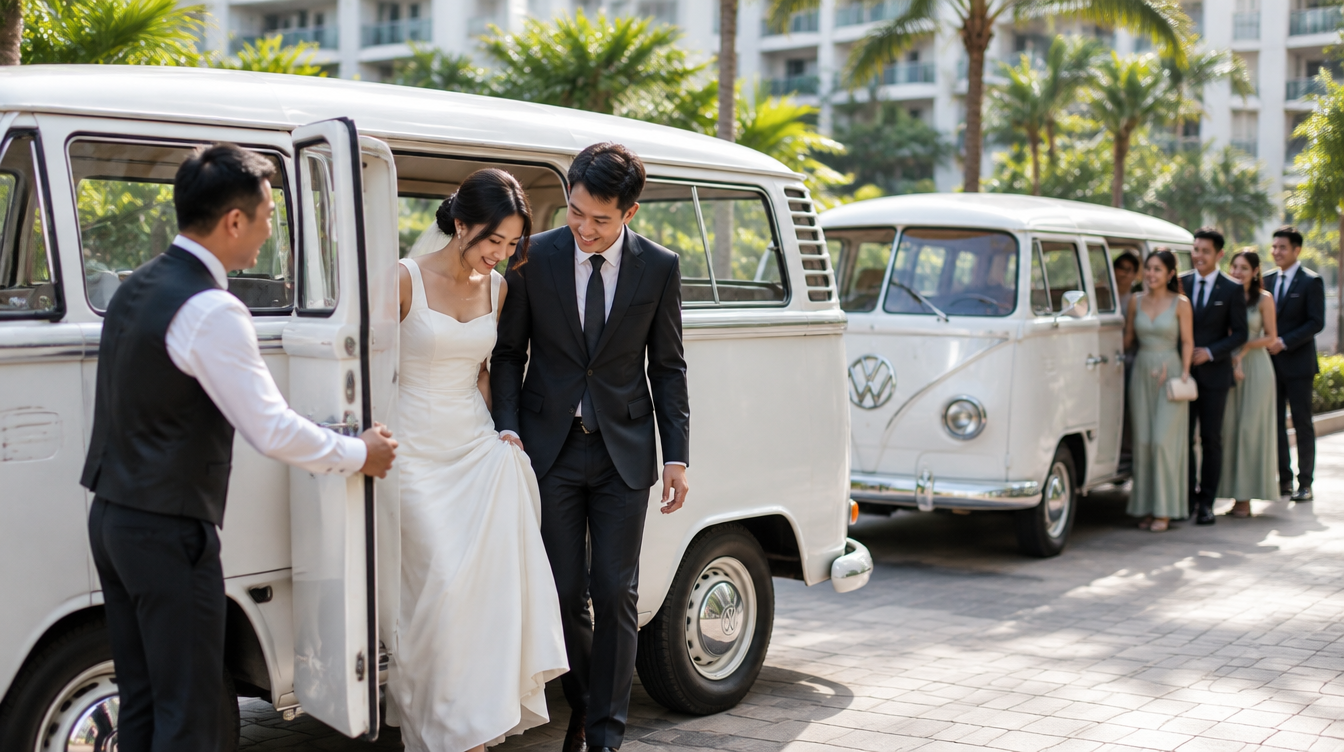
Two vintage Kombi Buses idling outside a Bukit Timah bungalow, engines running, doors open, and nobody quite sure which one should pull away first. It is a small moment, easily overlooked when a couple is still choosing fabric swatches and flower colours, but it is exactly the kind of detail that decides whether a wedding morning feels calm or chaotic.
More Singapore couples are now booking a second, and sometimes a third, wedding car for their bridal party rather than squeezing parents, bridesmaids and groomsmen into a single vehicle. Coordinating multiple wedding cars well means the day still reads as one seamless arrival, not two separate convoys that happen to be heading to the same address. It also means fewer surprises for the couple, who should be thinking about vows and photographs that morning, not chasing updates from two different drivers.
When One Car Isn’t Enough
Deciding how many wedding cars you need for a typical Singapore guest list is a separate question, one we’ve already explored. Once that number is settled, though, a different challenge takes over: getting two or three vehicles to move as a single, well-timed fleet instead of a loose cluster of cars that happen to be going the same way.
Setting a Departure Order That Actually Works
The instinct is often to send the bridal car off first, since it feels like the star of the morning. In practice, the opposite usually works better. A car carrying parents or close family tends to leave a few minutes ahead, so they are already in place, composed and ready, by the time the couple’s car turns into the driveway. The bridal car itself follows on a slight delay, timed against the venue’s distance, not a fixed clock.
Build a genuine buffer between departures, not just a minute or two. Ten minutes is a comfortable gap for most Singapore routes, enough to absorb a slow lift lobby, an ERP queue, or a driver circling for a parking bay without the second car catching up to the first at a red light. None of this needs to be complicated, but it does need to be written down: a simple departure sheet, shared with both chauffeurs and whoever is managing the morning at each house, removes the guesswork that turns a straightforward plan into a scramble five minutes before the cars are due to leave.
Arriving in the Right Sequence
Arrival order counts for just as much as departure order, particularly if a photographer is waiting to capture the couple stepping out. A second car pulling up mid-photograph, doors opening and six people spilling onto the same short stretch of pavement, tends to crowd a shot that should feel intimate.
Before the day itself, it helps to confirm a short list with both chauffeurs:
- Which car leads at each stop, and which one holds back
- A rough arrival window agreed with the photographer or videographer
- Where the second car should park so it doesn’t block the entrance being used for photographs
- A simple backup plan if traffic separates the two cars by more than a few minutes
- Who greets each car on arrival, so nobody is left waiting on the kerb
With that settled, the second car can hang back deliberately, giving the couple a clear minute or two at the entrance before the rest of the party joins them.
Keeping Chauffeurs Connected on the Day
However carefully a timeline is written, it only holds up if the people driving it can talk to each other. A shared messaging group between both chauffeurs, with one person, often the couple’s day-of coordinator instead of the couple themselves, able to nudge timings in real time, tends to work better than either driver guessing at the other’s progress. Small updates such as “five minutes out” or “held at the barrier” cost nothing to send and save a great deal of second-guessing on the ground.
This kind of coordination becomes more important during Singapore’s peak wedding months. With more than twenty-six thousand marriages registered across the country in a single recent year according to the Singapore Department of Statistics, October to February sees venues, photographers and transport all booked tightly together, and a five-minute delay for one car can ripple through a morning shared with several other weddings at the same venue. Agreeing a short contingency plan in advance helps too: which route each chauffeur takes if the main road is jammed, where to regroup if the cars become separated, and who makes the call if the whole schedule needs to shift by ten minutes.
A Few Practical Notes for Bigger Bridal Parties
Larger bridal parties often include grandparents or older relatives who need a little more time getting in and out of a vehicle, and it makes sense to assign them to whichever car has the easier step and the shorter walk to the entrance. A few extra minutes built into that car’s schedule, instead of expecting everyone to move at the same pace, keeps the whole convoy moving without anyone feeling rushed. It is a small adjustment, but one that guests tend to remember long after the day is over.
Getting Your Whole Party There Together
A wedding morning with more than one car does not need to feel more complicated than one with a single vehicle. It simply asks for a little more planning: a clear departure order, an agreed arrival sequence, and chauffeurs who are talking to each other instead of working things out on the fly.
If you are weighing up how to fit a growing bridal party into your wedding-day transport, our team is glad to help you sort out the sequencing well before the big day itself. Feel free to get in touch and we can talk through what would work for your venues and your guest list.