
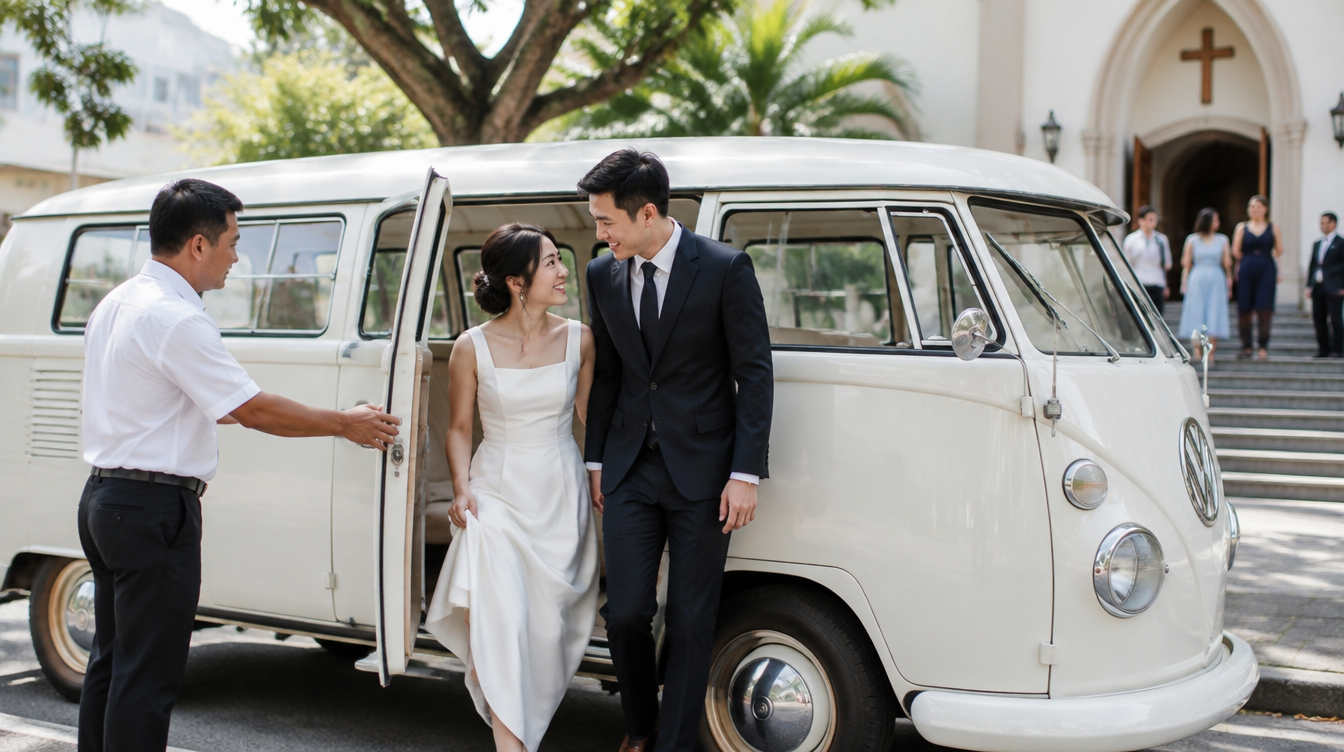
A bride stepping out of a chapel in Katong or Queenstown onto a waiting Volkswagen Beetle is one of the quieter images of a Singapore wedding season, yet it belongs to one of the island’s oldest marriage traditions. Singapore’s Eurasian community, tracing its roots to Portuguese, Dutch and British settlers who married into local families generations ago, still weds largely through the Catholic church, and that single fact changes almost everything about how a wedding car should be timed.
For couples planning a Eurasian wedding in Singapore, the transport brief looks a little different from a straightforward hotel ballroom booking. Mass has its own rhythm, family blessings sometimes happen somewhere other than the ceremony venue, and the reception has, for generations, unfolded at a family home as often as a function room. Getting the car schedule right starts with understanding where each of these moments actually happens, not just what time the invitation says to arrive.
A Day Anchored in the Church
Most Eurasian weddings in Singapore still centre on a Catholic Mass, usually held on a Saturday morning or early afternoon. Preparations for the service typically begin around six months out, and couples often have their banns, the formal wedding announcement, read at Sunday Mass three weeks before the big day itself, a structure documented in the National Heritage Board’s record of Eurasian wedding customs. Knowledge of how the day should unfold tends to pass down orally within families instead of through a wedding planner, which means two sets of parents can sometimes have slightly different expectations of how the morning should run. None of this changes the mechanics of hiring a wedding car, but it does mean the ceremony slot is usually fixed well in advance, giving a chauffeur a stable anchor point to plan arrival and departure around instead of guessing at a flexible timeline.
Timing the Car Around Mass, Photographs and the Register
The church service itself tends to run forty-five minutes to an hour, longer if a full nuptial Mass is said instead of a shorter ceremony. Couples should build in a buffer on either side: enough time before the service for the bridal car to arrive without rushing anyone up the aisle, and enough afterwards for the newlyweds, the wedding party and extended family to gather for photographs on the church steps before the convoy moves on.
Register signing adds another small but easily missed stretch of time. It usually happens straight after the ceremony, inside the church or in an adjoining room, and a driver who has not been told about it will often assume the couple is ready to leave the moment the final hymn ends. Confirming this step with your transport provider ahead of time avoids an awkward wait with a car idling outside while the paperwork is finished indoors.
Weather deserves a mention too. An afternoon shower can turn a short walk from car to church porch into a soggy entrance, so many couples ask their driver to pull up as close to the entrance as the church compound allows, with a golf umbrella kept ready for the last few steps from kerb to door.
From the Church to the Celebration
Historically, the reception for a Eurasian wedding took place at the bride’s family home, with neighbours and relatives spilling out onto the void deck or garden for an evening of food and dancing, often to the Portuguese Eurasian folk song jinkli nona. Traditional spreads at these gatherings still lean on familiar dishes such as curry puffs, sausage rolls, sambal and semolina cake, served long after the church bells have gone quiet. Many families still hold at least part of the celebration this way, even when the main banquet has since moved to a hotel ballroom, restaurant or church hall. For transport, that can mean two stops rather than one: a shorter hop to a family gathering first, followed by a second leg to the main reception venue later in the afternoon or evening.
Each leg needs its own buffer, particularly if the family stop is in an older estate with narrow lanes or tight parking, where a chauffeur familiar with manoeuvring a full-sized vehicle through close Singapore streets makes a real difference. Couples who have already read up on church wedding transport in Singapore for a more conventional single-venue day will recognise the pattern here too: block out generous windows between legs instead of treating the schedule as one straight line from ceremony to reception.
Small Customs That Still Shape the Schedule
A handful of smaller Eurasian customs touch transport planning as well. It remains common for the newlyweds’ car to leave the church decorated with “Just Married” signage, a nod to the same custom seen in old family photographs passed down through the generations. The day after the wedding is often set aside for gratitude visits, with couples calling on relatives and friends who helped with preparations, which for some families means booking a car for a second, quieter outing, since the wedding day itself is only one part of the celebration.
Comfortable Transport for Every Generation
Eurasian weddings in Singapore tend to draw a wide span of ages, from grandparents who remember a neighbourhood wedding from decades past to young cousins attending their first church ceremony. A vintage Kombi Bus suits this well because it seats a small group together instead of scattering family members across several private cars, which helps when an elderly relative would rather not cross a car park alone.
None of this needs to be complicated. A clear run sheet shared with your driver well ahead of the big day, covering the church slot, the register signing, any family stop and the final reception venue, does most of the work. The rest comes down to a chauffeur who has done this before and knows that a church wedding morning rarely moves in a straight line, particularly once family tradition is added to the mix.
If you are mapping out transport for a multi-stop wedding morning and want a fleet that can move easily between church, family gathering and reception, feel free to get in touch and we will help plan the day around your schedule and your traditions.