
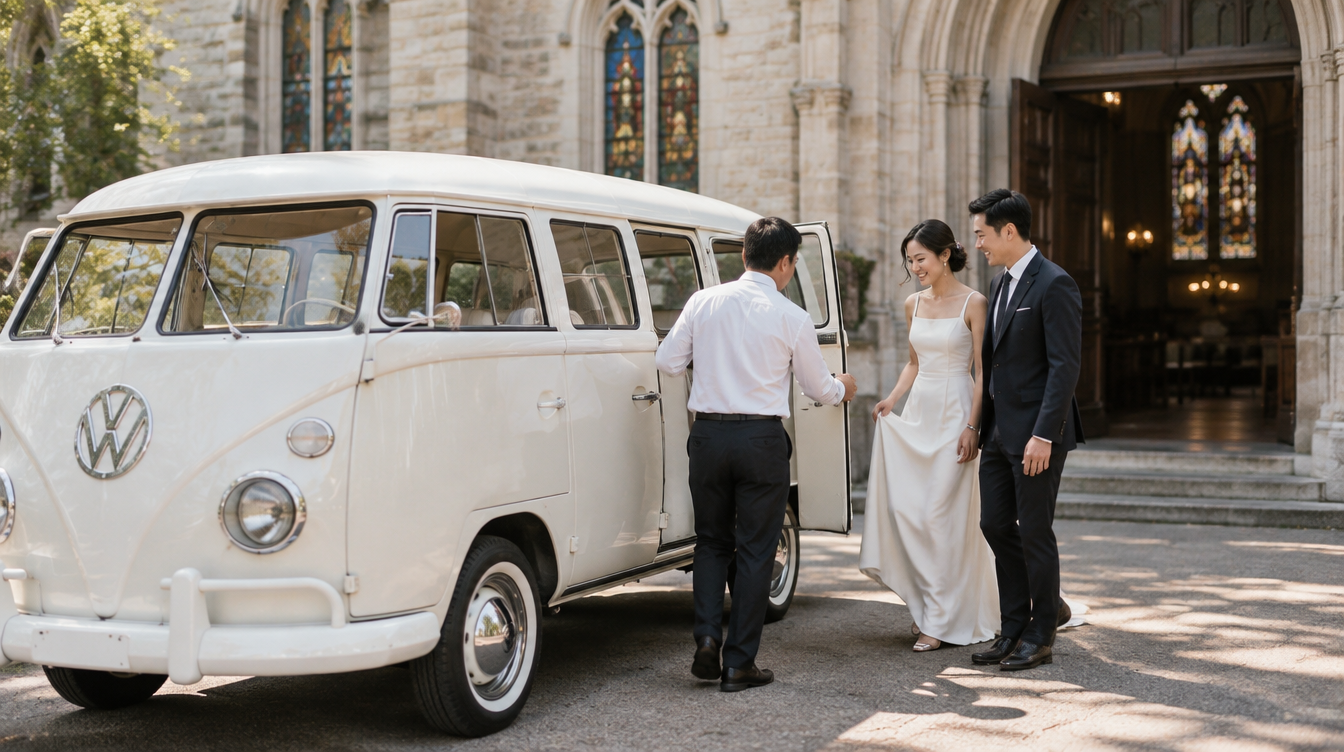
The organist reaches the final chord, confetti catches the light at the church steps, and somewhere at the kerb a chauffeur is already easing the door shut on a couple who have about forty minutes before their guests expect them at the reception. For couples planning a wedding in Singapore, this stretch between the ceremony and the party is often the least discussed part of the day, even though it shapes almost everything that happens after the vows.
Unlike a home-based tea ceremony or a hotel solemnisation, a church wedding almost always means two separate addresses, two separate crowds, and a block of time in between that has to work for photographs, well-wishers and travel. Getting the transport right here is less about how the car looks outside the church, though it usually looks lovely, and more about a timeline that holds together once traffic, weather and a few determined relatives get involved.
The Two-Stop Shape of a Church Wedding Day
Most Singapore church weddings run to a fairly consistent shape: a morning or early afternoon ceremony at the church, an hour or two set aside afterwards for photographs and family time, and then a reception that might be a short drive away or clear across the island at a hotel or restaurant. Each leg needs its own buffer, because a ceremony that overruns by fifteen minutes, or a photographer who wants one more shot at a favourite corner of the church grounds, has a way of eating into the gap you thought you had before the first guests arrive at the reception venue. Many of the same principles behind stress-free wedding transportation on a single-venue wedding day apply just as much, sometimes more, once a church and a reception sit at opposite ends of the island.
Building the Timeline Backwards from the Ceremony
The most reliable way to plan church wedding transport in Singapore is to work backwards from the moment guests are expected at the reception, instead of forwards from the ceremony start time. Decide when the first toast or the start of dinner service needs to happen, then subtract travel time between venues, a realistic photography window, and time for the bridal party to freshen up before walking in.
A rough guide for a typical church-to-reception transfer across Singapore runs to about thirty minutes on the road, though this should always be checked against the actual route and time of day. Saturday afternoon traffic around town-centre churches and CBD-adjacent hotels can add considerably more, especially during the October to February wedding season when several ceremonies are often finishing within the same hour at nearby venues.
It helps to build in a fifteen to twenty minute buffer beyond whatever the map suggests, and to agree this buffer with the chauffeur ahead of time instead of leaving it as an assumption. A driver who already knows the couple wants to arrive with breathing room, not right on the clock, can make small routing decisions on the day without needing to check in first.
Questions Worth Asking Your Wedding Car Provider
Because a church wedding involves more moving parts than a single-venue celebration, it helps to go into vehicle bookings with a short list of practical questions instead of assuming these details will simply work themselves out.
- Whether the chauffeur already knows the drop-off and pick-up points at both the church and the reception venue.
- How a timing buffer for photographs is handled if the ceremony overruns.
- Whether a second car is available for the wider bridal party, not just the couple.
- What the contingency plan looks like if rain affects an outdoor photograph stop between venues.
- How multiple vehicles are paired to look consistent, from colour to plate, when more than one car is booked for the day.
Singapore’s showers can be sudden even outside the monsoon months, so it makes sense to check that morning’s outlook with the Meteorological Service Singapore and have the chauffeur ready to adjust the outdoor stop if the sky turns.
The Paperwork Behind the Photographs
A church wedding is a deeply meaningful ceremony, but on its own it doesn’t register a marriage in the eyes of Singapore law. Couples still need to solemnise and register their marriage through the civil marriage process, either before or after the church service, and many choose to fit this in as a quiet, separate appointment instead of folding it into the wedding day itself. Where this affects transport planning is timing: a same-day registration appointment, perhaps a short slot before or after the church service, needs its own place on the route with its own buffer, just like any other stop, while a separate-day registration simply stays off the wedding-day itinerary altogether.
Choosing a Car That Suits the Setting
The all-white profile of a vintage Volkswagen Kombi Bus or Beetle tends to sit particularly well against the stone or stained glass of a church facade, giving photographers a clean, timeless backdrop that does not compete with the architecture. Couples who have chosen a fairly formal or traditional ceremony often find the vintage silhouette echoes that tone better than a modern saloon would.
Interior space counts too, particularly for a bride in a long gown or veil who needs to step in and out of the car without help at both the church and the reception. A Kombi Bus, with its higher roofline and wider door opening, tends to be the more forgiving choice for elaborate outfits, while a Beetle suits a simpler gown and a couple who want a more intimate, two-seat arrival.
None of this needs deciding on the day itself. A short conversation with the wedding car provider ahead of time, ideally alongside a look at the church’s own drop-off area, usually settles which vehicle and which entrance make the most sense. It is a small planning step, but one that saves the bridal party from working it out on the kerb in full view of arriving guests.
A church wedding carries its own rhythm, one built around a ceremony, a gap, and a second gathering that couples are often planning for the first time. Getting the timing and the vehicle right does not need to be complicated. It mostly comes down to working backwards from the reception, building in honest buffers, and choosing a car that fits the mood of the morning as well as the practicalities of the afternoon.
If you are mapping out transport for a church wedding, or simply want a second opinion on timing before you lock in your vendors, feel free to get in touch and we will help you think it through.