
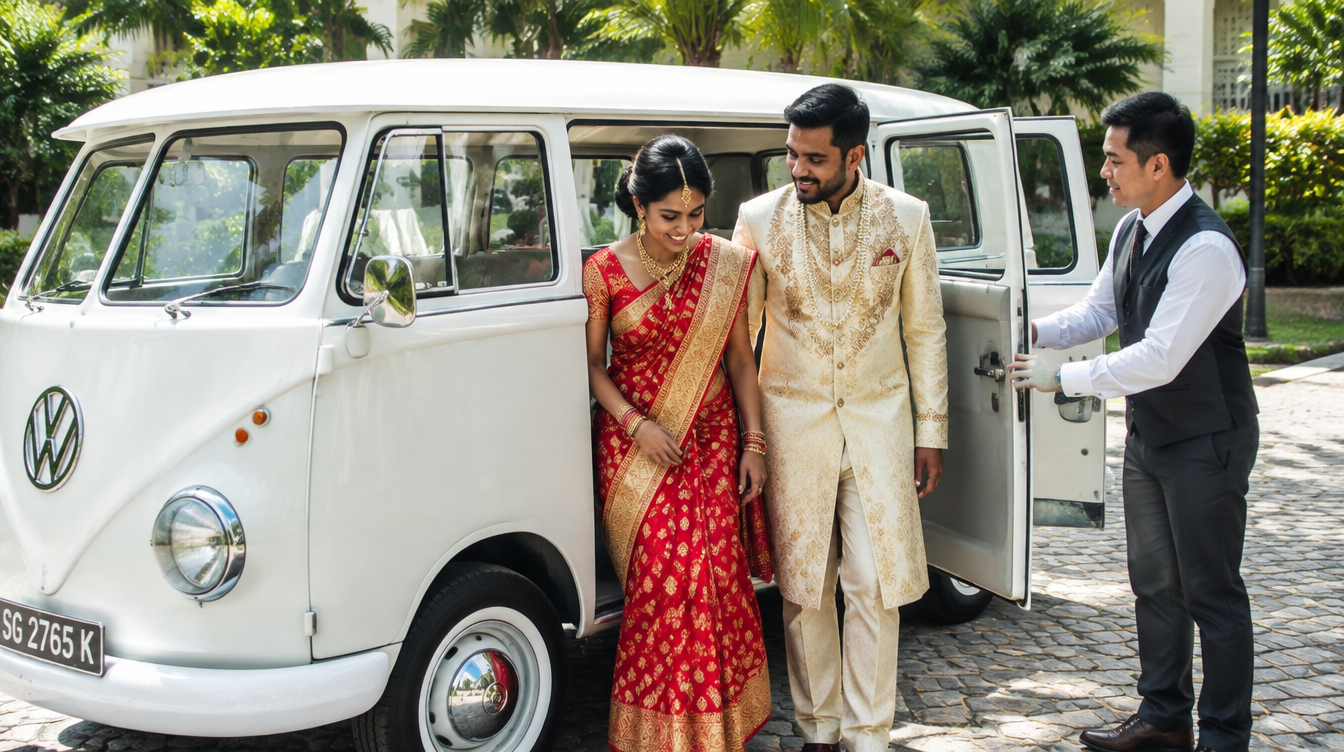
The priest consults the calendar months before the couple does. For many Singaporean Indian families, the wedding date itself is not chosen by preference but by muhurtham, the auspicious window calculated for the couple by a family priest or astrologer, and it can fall at an hour that has nothing to do with convenience. A car that arrives five minutes late is not a small slip when the entire ceremony is built around a specific moment.
That single fact changes how Indian wedding transport needs to be planned in Singapore, more than almost any other element of the day. Where other couples might treat the car booking as a formality to confirm closer to the date, this kind of wedding transport plan often has to work backwards from a fixed ritual clock.
Why the Auspicious Hour Comes First
Muhurtham is set using the couple’s birth details, and it is treated as fixed rather than flexible. Some families receive a single narrow window, perhaps forty minutes, within which key rituals must take place. Others are given a short list of acceptable times across the morning. Everything downstream of that hour, the hairdresser’s schedule, the florist’s delivery, and the car’s arrival at the temple or venue, gets planned in reverse from it. A chauffeur who understands this is not simply driving to an address; they are driving to a deadline that was fixed before the venue was even booked.
The Rituals That Travel With the Couple
A Tamil-Hindu wedding ceremony in Singapore typically unfolds in a fixed sequence at the temple or banquet hall, with the couple seated before a ceremonial fire, lamps, and offerings of fruit and flowers. Partway through, the bride steps away to change into a fresh outfit, and while she is gone, the garlands the couple wore are passed among guests for blessing.
When she returns, the groom ties the thali, a gold pendant, around her neck, and the couple exchanges garlands as guests shower them with saffron rice. The ceremony closes with the couple circling the sacred fire three times, grain thrown into the flames with each turn, as described in the National Heritage Board’s overview of Tamil-Hindu wedding traditions.
None of this moves quickly, and little of it bends easily for a car running behind schedule. A wedding car team that has sat through a few of these ceremonies learns to read the rhythm of the day almost as well as the priest does, and to keep the chauffeur briefed on which ritual comes next instead of simply waiting at the kerb.
Mapping the Day Before You Book a Car
Because so much of an Indian wedding in Singapore is built around fixed timings, the planning conversation with a transport provider has to start earlier than it might for other weddings. A good starting point is working through the practical details together, well before any car is confirmed.
- The muhurtham window, and how much buffer exists on either side of it
- Whether the ceremony, any pre-wedding rites, and the reception sit at the same venue or are spread across several
- How many vehicles the bridal party and immediate family will need
- Whether elderly relatives need a car with easier entry and exit
- Who on the day will coordinate timing between the priest, the photographer, and the chauffeurs
Working through this list early gives the chauffeur something firmer to plan around than a rough time of day. It also means the car is positioned to respond if the priest’s final confirmation shifts the schedule by twenty minutes either way, which happens more often than most couples expect.
The Temple, the Reception, and the Stops In Between
Many Singaporean Indian weddings move between locations across the day, a morning ceremony at a temple or community hall, followed by a separate reception venue in the evening, sometimes with a change of outfit in between. That kind of multi-stop day calls for the logistical choreography that applies across cultural celebrations, sequencing multiple vehicles, managing chauffeur coordination, and timing arrivals so the photographer is not caught out. Couples coordinating multiple wedding cars for a large wedding party will recognise the pattern, even if the ceremony itself looks quite different.
Dressing the Fleet for a Multicultural Celebration
The all-white, chauffeur-driven Kombi Buses and Beetles in the WeddingCar.sg fleet were never designed around one tradition. The same vintage silhouette that suits a church procession or a Peranakan tea ceremony sits comfortably outside a temple too, and the white finish photographs well against the bright colours of a traditional Indian wedding outfit.
Car plate selection remains part of the planning conversation regardless of the ceremony style. Families who want a particular number or combination for the day can flag it early, and the fleet is paired to the couple well in advance, so there is no scrambling on the morning itself.
Building in Buffer for the Unexpected
Singapore traffic does not know or care that a muhurtham window closes at a precise minute, and neither does an unexpected downpour. The safest plans build in buffer time at every stage, between the hairdresser and the car, between the car and the temple, and between the temple and the reception. A chauffeur briefed on the ceremony’s structure can also judge, in the moment, whether to take a longer but more reliable route instead of the fastest one on the map.
Every wedding in Singapore carries its own rhythm, and for an Indian wedding that rhythm is often fixed months in advance by a priest with a calendar, not by a couple choosing a preferred time. Getting the transport right means listening to that rhythm from the first planning conversation, not fitting it in once the venue and the outfits are settled. If a muhurtham, a multi-venue day, or a large family convoy is part of your plans, get in touch and we will help build the timeline around it.