
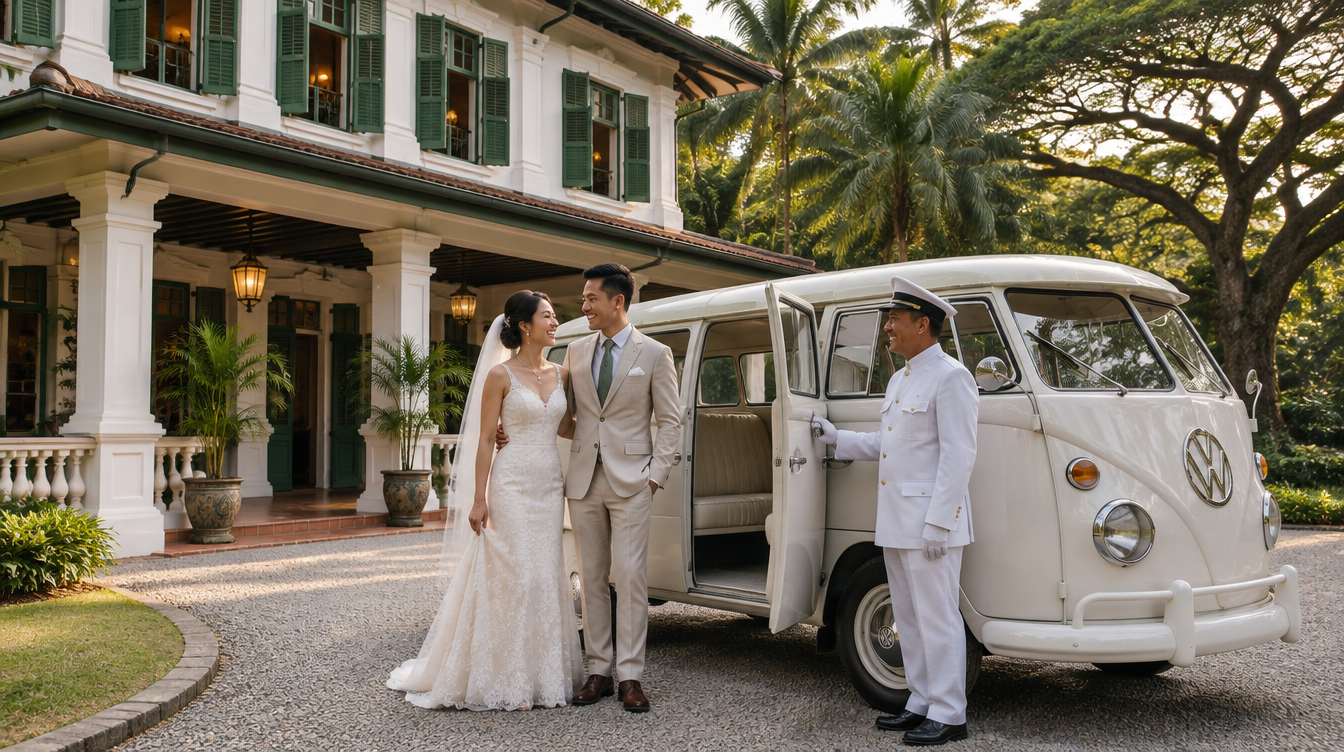
A colonial mansion on a hill, a chapel hall with a centuries-old courtyard, a black-and-white bungalow tucked behind rain trees: Singapore’s heritage venues give a wedding a setting no hotel ballroom can quite match. They also ask more of the car arriving at the front step than most modern venues ever do.
The same hillside charm that makes the photographs beautiful usually comes with a narrower approach road, a gravel forecourt built for strolling, not parking, or a conservation building with its own quiet rules about where vehicles may sit. None of this needs to disrupt the morning. It simply needs planning that starts earlier than it would for a hotel or a condominium, a chauffeur who has seen the road before, and a little patience from everyone involved on the drive up.
Why Heritage Venues Drive Differently
Most hotel driveways were designed after the motor car, with a covered porte-cochere built to receive a queue of vehicles in quick succession. A heritage mansion or hall was usually built decades, sometimes a century, before anyone needed to plan wedding car access for a fleet of vehicles at all, so the forecourt, the gate and the final stretch of road were never meant to carry that kind of traffic. Working with the building’s original design, instead of expecting it to behave like a modern venue, is what keeps the arrival calm. A little extra lead time, and a chauffeur briefed on the property’s quirks, usually does more good here than any amount of hurrying on the day.
The Approach Road Is Not the Driveway
A colonial mansion on one of Singapore’s southern hills, for instance, is typically reached by a single climbing lane that winds through parkland before it ever reaches the building itself. It is a lovely drive. It is also narrow enough that a Kombi Bus meeting a delivery van or a florist’s lorry coming the other way has nowhere to pull aside, which is precisely the kind of delay a tight morning schedule cannot absorb.
A chauffeur who has driven the route before, at roughly the hour the wedding car will use it, knows where that bottleneck tends to form and can time the ascent around it. Confirming an exact arrival slot with the venue’s event coordinator, instead of a loose morning window, gives the chauffeur something firm to plan the climb against, and lets the venue hold the lane clear if other vendors are due around the same time. Some properties can also arrange for a staff member to stand at the trickiest bend and wave the car through, which costs nothing and settles everyone’s nerves.
Where the Car Actually Parks
Heritage forecourts are frequently gravel, cobblestone or protected lawn, laid out to be walked across and photographed, not idled on. The usual pattern is a short drop-off directly at the entrance, followed by the car relocating to a nearby lot or a roadside bay while the ceremony or reception runs its course, then returning closer to the end for the send-off. Some properties manage this relocation themselves through an on-site valet team; others simply expect the chauffeur to handle it, so couples should ask which applies before the day arrives.
For an entourage with more than one vehicle, this relocation needs its own plan. A second or third car waiting at the base of the hill, brought up only when needed, keeps the forecourt from becoming congested and spares later arrivals the same narrow-lane problem described above.
The veranda or portico that drew the couple to the venue in the first place is usually also the best spot to bring the car for photographs, briefly, before it moves on. A few points are best settled with the venue ahead of the day:
- the exact drop-off point and whether it can take a Kombi Bus’s turning circle
- how far away the car will wait once photographs are done
- how long the car may stay at the entrance for photographs before it needs to relocate
- where guests with mobility needs should be dropped instead
- a sheltered fallback spot if rain arrives during the drop-off
Conservation Courtesies to Keep in Mind
Many of Singapore’s heritage mansions and halls sit within areas the Urban Redevelopment Authority has gazetted for conservation, and the buildings themselves often come with their own house rules around noise, idling engines and anything attached to the historic facade. URA’s guidelines for buildings in conservation areas set out the broader framework these properties sit within, and a quick check with the venue’s own management beforehand is usually enough to confirm what applies on the day itself.
Timing the Hillside Climb
The discipline behind planning car access at your hotel ballroom applies just as much here, only adapted for terrain instead of traffic. A flat porte-cochere forgives a few minutes’ delay; a winding hill road, shared with other vendors’ vehicles, generally does not. The timing buffer that feels generous at a hotel often needs stretching further at a hillside property, simply because there is less room to make up lost minutes once the car is on the climb.
Building a slightly wider buffer into the schedule for the drive up, and briefing the chauffeur on exactly where the venue team will be waiting to direct the car, counts for more at a heritage property than almost anywhere else on this list. It is a small adjustment that protects the one part of the morning nobody wants rushed, and it costs nothing beyond a phone call made a few weeks ahead of time.
A Composed Arrival, Wherever You Marry
Heritage venues reward the couples willing to plan a little further ahead for them, and a car that knows the climb, the forecourt and the handover points in advance tends to arrive looking exactly as unhurried as the setting deserves. A short site visit with the chauffeur beforehand, if the venue allows it, often settles more than a dozen phone calls ever could. If a colonial mansion or a heritage hall is on your shortlist, our team is glad to walk through the access details together; get in touch whenever you are ready to start planning.