
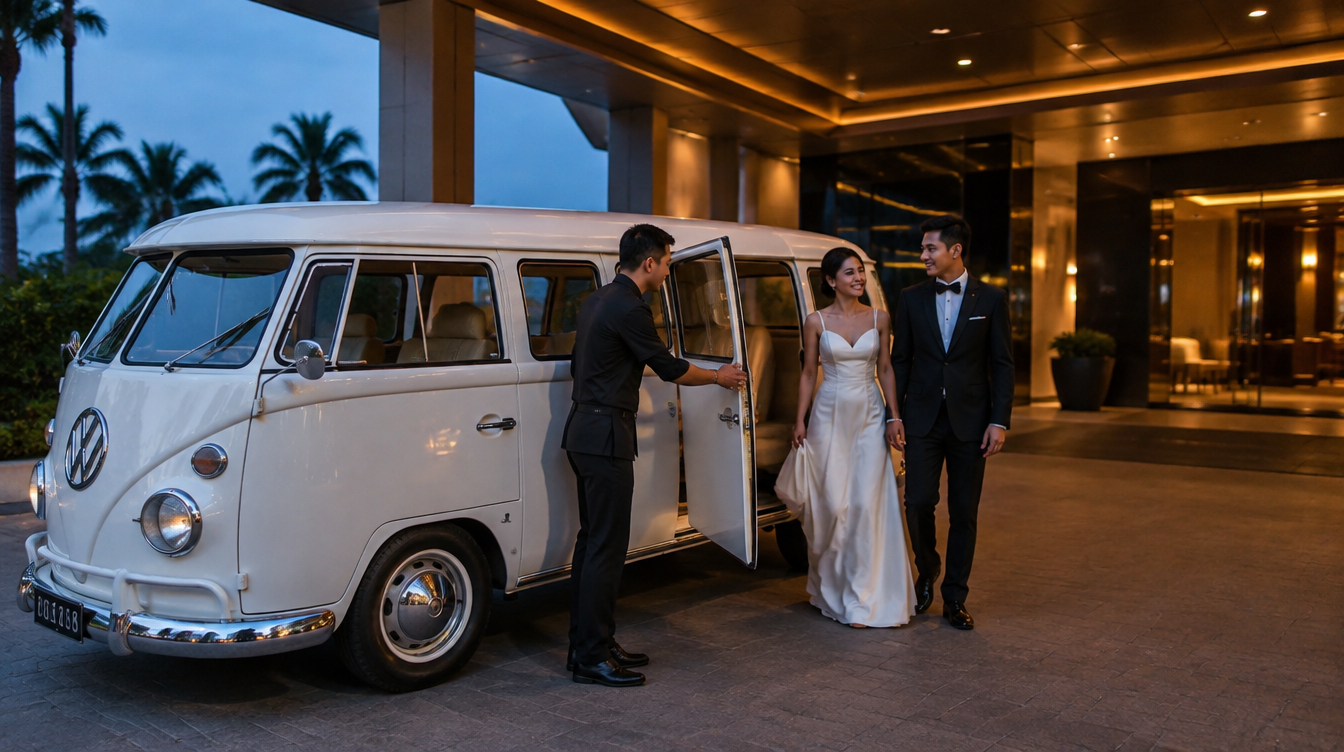
Somewhere around six in the evening, long after the morning’s gate-crashing games have been forgotten and the last photograph at the void deck has been taken, a second and quieter kind of pressure sets in: getting everyone to the ballroom on time. The evening wedding banquet is, for many Singapore couples, the part of the day with the largest guest list and the least room for error, yet it is often the leg of transport planning that gets the least attention.
That is a mistake worth avoiding. A banquet’s start time is fixed in a way the morning rarely is, printed on invitations and expected by a room full of relatives, and a wedding car arriving flustered or late at the hotel porte cochere sets an entirely different tone to one that glides in with five minutes to spare.
Why the Evening Leg Needs Its Own Timeline
Treating the banquet arrival as an afterthought to the day’s main timeline is the most common planning slip we see. The morning and afternoon stretch of a wedding day usually has built-in flexibility: relatives arrive a little late, a tea ceremony runs long, a photographer asks for ten more minutes at a favourite spot, and none of it derails anything because there is no fixed external deadline to meet. The evening banquet changes that completely, because a function room, caterers and a guest list of two hundred people do not wait.
We generally recommend treating the banquet as its own mini-event with its own call time, built backwards from when guests are expected to be seated, not forwards from whatever time the earlier ceremony finishes. That single shift in thinking, planning backwards instead of forwards, tends to solve most of the timing problems before they start.
Building In a Buffer Between Ceremony and Banquet
A gap of at least ninety minutes between the final photograph of the afternoon and the scheduled banquet start gives you room for a change of outfit, a touch-up to hair and makeup, and the drive itself without anyone checking their watch. Couples who skip this buffer because the two venues look close together on a map are often the ones who end up asking their chauffeur to bend the traffic rules, which nobody wants to do on a wedding day.
Coordinating With Your Chauffeur Before Peak-Hour Traffic
If your banquet falls on a weekday evening, the drive between venues may cross some of the busiest stretches of road on the island during the exact hours when traffic is heaviest. A chauffeur who already knows the route, and who has been briefed on your preferred departure window instead of being left to work it out on the day, can quietly reroute around a jam without anyone in the car needing to know it happened.
Your route may also cross gantries covered under ERP’s evening operating hours, and pricing and congestion on these stretches can shift noticeably as the evening peak sets in. None of this changes how the evening unfolds for you and your guests, but it does shape how early your chauffeur ought to be told to leave.
We also suggest sharing the banquet venue’s exact drop-off point with your wedding car provider well before the day itself. Many Singapore hotels have more than one entrance, and a chauffeur who has confirmed the correct porte cochere in advance saves everyone a slow, undignified loop around the building while photographers wait.
What Happens If the Programme Runs Late
Every wedding day runs late somewhere, and the honest answer is that a well-briefed chauffeur builds in contingency instead of hoping nothing goes wrong. We ask couples for a realistic range instead of a single fixed time, so the car can be positioned and ready the moment it is actually needed, instead of sitting idle for an hour or scrambling at the last minute.
Questions Worth Asking Your Wedding Car Provider Before the Evening Leg
A short conversation with your transport provider in the weeks before the big day tends to catch most of the gaps that would otherwise surface only on the evening itself. It need not be a long call, and most providers will have answers ready if you simply ask.
Worth raising:
- Has the chauffeur confirmed the banquet venue’s exact drop-off entrance, instead of relying on the main address alone?
- Is there a backup plan if the afternoon programme overruns by thirty minutes or more?
- Will the same car and chauffeur handle both the afternoon and evening legs, or is there a handover?
- How much notice does the provider need if the banquet start time shifts in the final week?
- Is there a quiet, sheltered spot near the porte cochere where the car can wait if it arrives early?
- Does the booking already account for a possible outfit change between the ceremony and the banquet?
A Second Change of Attire, a Second Car Moment
Many couples change into a different outfit for the evening, and that second change deserves its own small arrival moment instead of being treated as a quiet slip through a side door. If your day began with a Chinese tea ceremony transport leg in the morning, the contrast is one to lean into: a formal, composed arrival at the banquet in the evening, car doors opened for you just as they were at the first stop of the day.
Guests who missed the morning’s events entirely will often only ever see this one arrival, which makes it worth treating with the same care as the ceremony itself, even though the morning usually gets all the planning attention.
Getting the evening leg right rarely needs anything dramatic. It comes down to an honest buffer, a chauffeur briefed on the route and the venue, and a plan for the moments that do not go exactly to schedule. If you would like help mapping out your own day’s timing, from the first car of the morning to the very last arrival of the night, please feel free to get in touch and we can talk through what the rest of your celebration will need.