
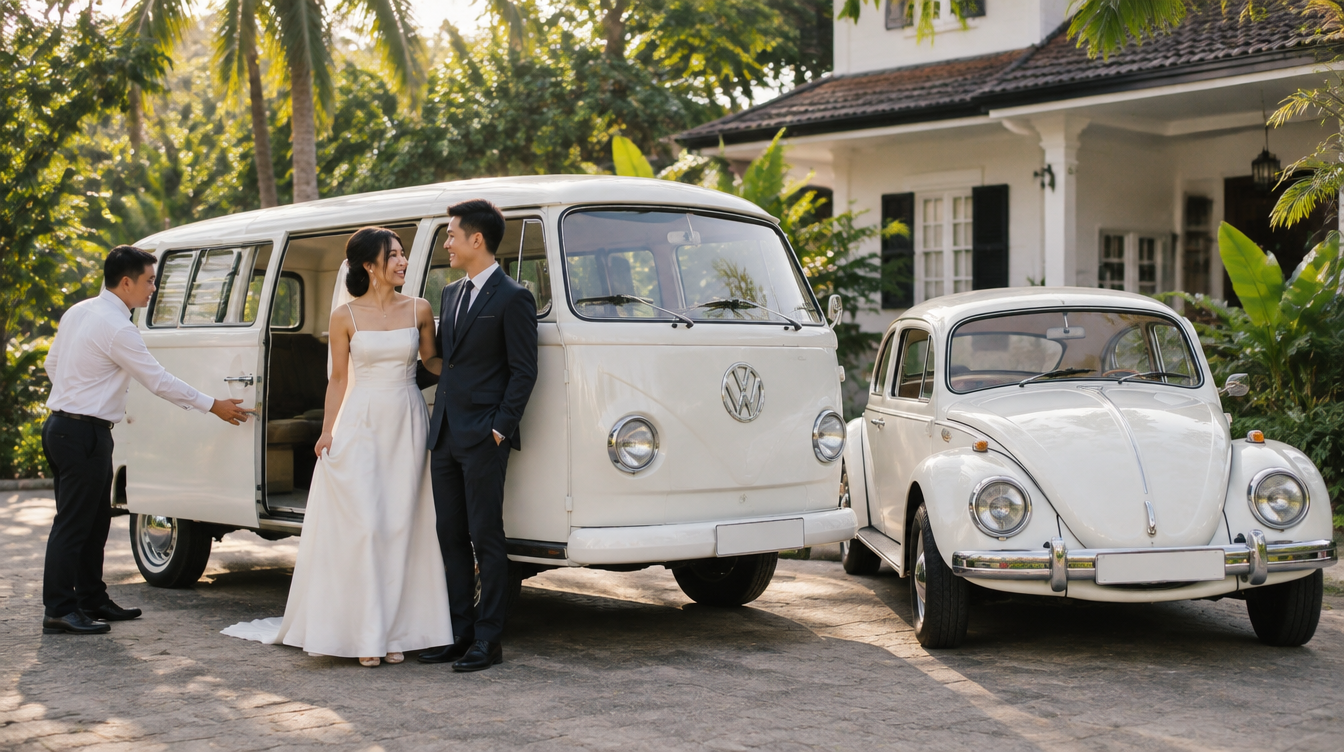
Ask ten Singapore couples why they chose a vintage wedding car over a modern hire car, and most will mention a single moment: the look on their guests’ faces when the car rounds the corner. Fewer can explain why they ended up with a Kombi Bus rather than a Beetle, or the other way round. The choice often comes down to instinct on the day of the site visit, when a couple sees both parked side by side and one simply feels right.
That instinct deserves attention, but it helps to know what is actually driving it. A vintage wedding car in Singapore is rarely just a backdrop for photographs. It carries an entourage through gate-crashing games, tea ceremonies, hotel drop-offs and the long wait between venues, and the Kombi Bus and Beetle serve that day very differently. Knowing where each one shines makes the decision easier long before the site visit even happens.
Two Icons, One Decision
Both vehicles trace back to the same Volkswagen family, restored and repainted into the crisp all-white livery couples now recognise instantly outside Singapore’s churches, hotels and void decks. Beyond that shared heritage, though, they are built for almost opposite jobs. One is a compact two-door saloon designed to carry a couple. The other is a boxy, high-roofed van designed to carry a crowd. Deciding between them starts with being honest about which job your wedding day actually needs done. The fuller backstory of how these two vehicles became Singapore’s favourite vintage wedding cars explains a good deal of why couples respond to them so differently on a site visit.
What the Kombi Bus Brings to Your Day
The Kombi Bus earns its keep the moment an entourage exceeds two or three people. Its sliding side door swings wide open onto narrow HDB driveways and tight hotel drop-off points where a conventional car door would clip a pillar or a kerb, letting bridesmaids, parents or a bulky gown emerge without the usual scramble.
That same door and boxy shape make it the more forgiving choice for a bride whose gown has a long train or a wide skirt, since there is room to sit upright instead of folding into a low seat. Couples running a multi-stop morning, perhaps a gate-crash at the bride’s home followed by a solemnisation across town, often find the extra space buys them a few calmer minutes between stops instead of a rushed reshuffle of who sits where.
It also photographs differently. The Kombi’s split windscreen and rounded curves give photographers a distinctive silhouette to work with from further back, useful for a wide shot outside a venue with space to spare, though its size can feel slightly overpowering against a narrow shophouse frontage.
What the Beetle Offers Instead
The Beetle plays a quieter role. Its two doors and snug cabin were never meant for a crowd, and that is precisely its appeal for couples who want the arrival to feel private instead of grand: just the two of them, visible through a wide windscreen, gliding up to a venue with none of the bulk a larger vehicle brings.
It also suits venues where space is genuinely tight, a boutique hotel driveway or a heritage shophouse street with barely enough width for one car to pass, where the Kombi’s larger turning circle and height can become a practical liability instead of a photogenic one.
Questions Worth Asking Before You Decide
Before booking either vehicle, it helps to work through a short list of practical questions with your chauffeur service instead of choosing on looks alone:
- How many people, beyond the couple, genuinely need to travel in the wedding car itself, instead of a separate vehicle following behind?
- Does your gown or attire need extra room to sit without creasing, particularly for a long train or a formal cheongsam?
- How narrow are the driveways or drop-off points at your ceremony venue, reception venue and any homes involved in a gate-crash?
- Will the car appear mostly in wide establishing shots, close portraits, or both, and which vehicle suits that composition?
- Does your wedding theme lean toward an intimate, understated arrival or a fuller, more visible entourage moment?
A Little Kombi and Beetle History
Part of the appeal of either car is simply age. The Volkswagen Type 2, the van family that includes the Kombi Bus, first appeared in 1950 as Volkswagen’s second mass-production model after the original Beetle, built with a rear engine and a boxy, forward-control body that gave it far more usable space than a conventional car of the same era, according to Wikipedia’s history of the Volkswagen Type 2. The Beetle, by contrast, kept its compact two-door saloon shape largely unchanged for decades, which is exactly why it still reads as unmistakably vintage today.
Neither model was ever built with weddings in mind, which is part of the charm. Every Kombi Bus and Beetle now doing the rounds of Singapore’s wedding season has been fully restored and repainted specifically for this second life, a detail worth appreciating quietly as it rolls up instead of one that needs pointing out to your guests.
Timing Your Booking Around Singapore’s Wedding Season
Singapore’s wedding season runs roughly from October through February, when cooler evenings and a run of auspicious dates draw couples toward outdoor solemnisations and later receptions, and both vehicle types tend to book out earliest in this window. Close to 25,000 marriages were registered across Singapore in 2025, according to data.gov.sg, and even a modest share of those concentrated into five popular months puts real pressure on a limited fleet of restored vintage cars.
A couple who already knows which vehicle they want has an easier time securing it early, while one still deciding between the two loses valuable weeks going back and forth. If your date already falls within peak season, treat the Kombi-or-Beetle decision as one to close out within the first few weeks of venue booking, not something to leave until the final month.
For couples marrying outside peak season, there is more room to settle the decision later, though the same drop-off and entourage questions above still apply regardless of when the wedding falls. A well-matched car looks just as considered in July as it does in December.
- Peak season, roughly October to February: confirm your vehicle choice within the first few weeks of booking.
- Shoulder months either side of peak season: a few months’ notice is usually enough.
- Weekday weddings: generally easier to secure either vehicle at shorter notice.
- Multi-stop wedding days: book early regardless of season, since routing adds complexity for either car.
Whichever You Choose
There is no wrong answer between these two, only a better fit for the particular shape of your wedding day. Walk through your guest list, your gown, your venues and the mood you want your arrival to set, and the right one usually becomes obvious well before the ceremony itself. If you would still like a second opinion, get in touch and we can talk through which one suits your day.