
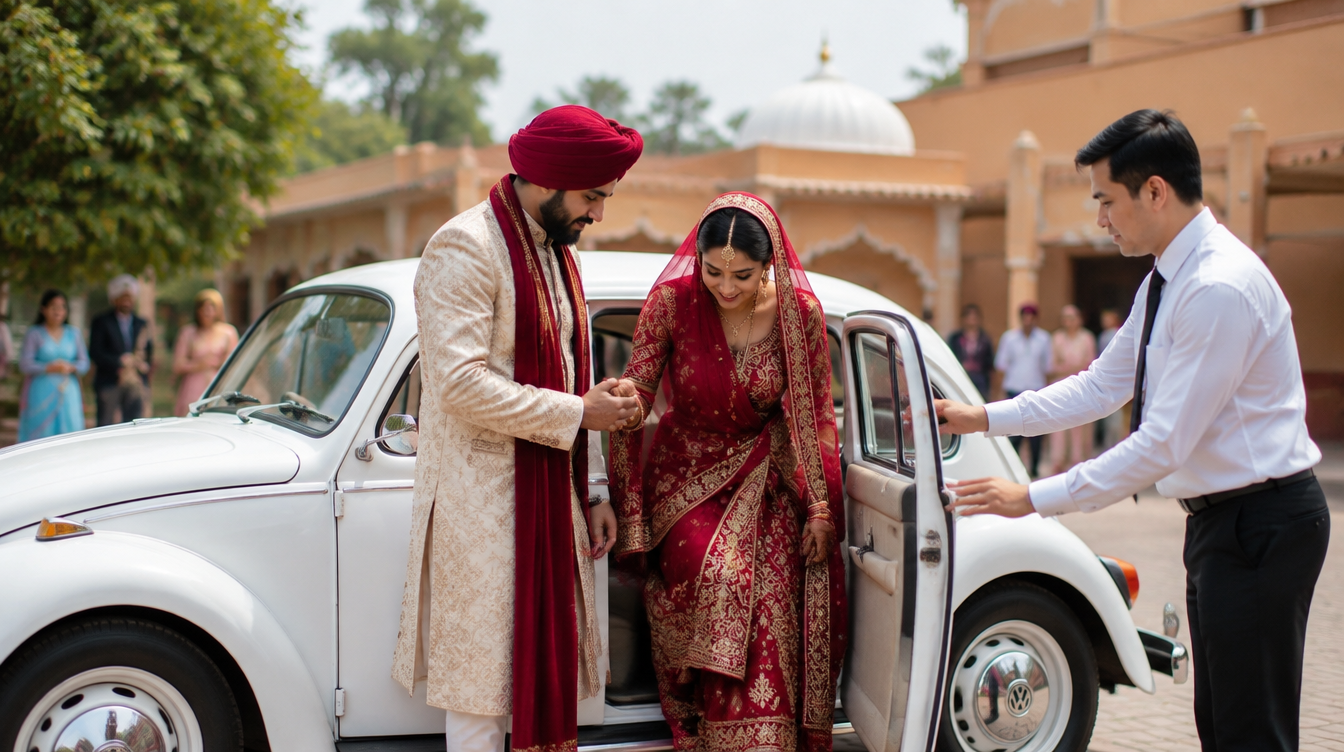
The dhol drums start well before the bridal car does. Outside a Gurdwara on a Saturday morning, a knot of uncles and cousins falls into step behind the groom, clapping to a rhythm that has announced Sikh weddings for generations, while somewhere behind them a chauffeur is quietly working out how to time his approach so the car does not block the very procession it is meant to be part of.
Sikh wedding transport in Singapore runs to a different rhythm than the ceremonies we usually plan around, and it deserves a map of its own, not a copy of someone else’s. A single wedding day can compress a procession, a three to four hour ceremony, a communal meal and, often, a separate evening reception, all before anyone changes out of their wedding clothes. Getting the cars right means understanding that shape first.
A Wedding Day Built Around the Gurdwara
The Anand Karaj, the Sikh wedding ceremony, is almost always held in a Gurdwara, not a hotel ballroom or garden. Before it begins, both families take part in the Milni, a formal greeting where relatives are introduced pair by pair, and only once that is done does the couple sit before the Guru Granth Sahib for the four Lavan, the circling that forms the heart of the rite. Most ceremonies wrap up before noon, which sets an early call time for the entire fleet, well before many other Singapore weddings are even stirring.
Singapore’s Sikh community is served by two main gurdwaras, the Central Sikh Temple on Towner Road and the Silat Road Sikh Temple, according to the National Library Board’s account of the community’s history in Singapore. Both sit in older parts of the city where loading bays are tight and drop-off points fill quickly on a wedding morning, so a chauffeur who already knows that stretch of road counts for more than one working from a map.
Getting the Baraat Right
The baraat, the groom’s arrival procession, is where a wedding car plan can quietly go wrong. Even when the groom has travelled most of the way by car, tradition calls for the last stretch to be covered on foot, with drummers and dancing family members leading the way to the Gurdwara entrance. A good transport plan treats this as its own event: a drop-off point set back far enough for the procession to gather and move at its own pace, and a chauffeur briefed to hold well clear instead of edging the car through a crowd that has every intention of taking its time.
Timing Around a Ceremony That Runs for Hours
Unlike a twenty-minute solemnisation, the Anand Karaj itself can run for three to four hours once the Lavan, hymns and blessings are all accounted for. That changes what the fleet is doing during the ceremony. Instead of shuttling guests between stops, the cars are largely parked and waiting, which means chauffeurs need somewhere sensible to sit for the best part of a morning, close enough to be ready but not blocking the compound.
Langar, the communal vegetarian meal that follows the ceremony, adds a further hour or more before anyone is ready to leave. Many Singapore couples then have a separate reception later the same evening, so the gap between the last course of langar and the first arrivals at the banquet hall needs a realistic buffer built in, not an optimistic one borrowed from the printed programme.
Weekend slots at both gurdwaras book out early during the busier months between October and February, so couples working out their wedding car schedule are usually doing it well before the rest of the day’s vendors are confirmed. Locking in a chauffeur and fleet against the ceremony date early avoids the scramble that tends to hit everyone else in December and January, and it gives the whole extended family one less thing to chase in the final fortnight.
From Gurdwara to Reception
Coordinating a hop across town after a long, unhurried ceremony is a challenge many Singapore couples share, not only Sikh families. Much the same choreography shows up in wedding transport for Singapore Indian ceremonies, where a morning ritual and an evening banquet sit hours and postcodes apart, and the same lesson applies here: build the second leg of the day around when the first leg actually finishes, not when it was scheduled to.
Small Logistics That Save the Day
Most of what keeps a Sikh wedding’s transport running smoothly is unglamorous and easy to overlook until the morning itself. A handful of small decisions, made early, keep the day from feeling rushed:
- A buffer of ten to fifteen minutes built into the schedule for the baraat’s slower pace before the Gurdwara doors.
- A drop-off point far enough back that the procession has room to gather without cars idling behind it.
- A second, smaller car on standby for parents or grandparents who would rather not wait through the full ceremony and langar.
- Confirmation with the Gurdwara, ahead of the date, on parking and loading access, since compounds vary considerably in size.
- A pickup window for the reception leg set around when langar realistically wraps up.
- A chauffeur who has been briefed on the day’s shape in advance, not just handed an address and a time.
None of this needs to be visible on the day itself. The couples who feel calmest getting into the car are usually the ones whose planning happened weeks earlier, quietly, with someone else holding the schedule.
A Sikh wedding asks more of a transport plan than most, but nothing about it is unmanageable once the shape of the morning is clear well in advance. Every family’s version of the day looks a little different, from the size of the baraat to how many relatives are travelling in from overseas, and a fleet that has been briefed properly can flex around all of it. If you are mapping out a Gurdwara ceremony and a reception that follows, we would be glad to talk through the timing with you. get in touch and we can help the two ends of your day meet in the middle, calmly and on time.