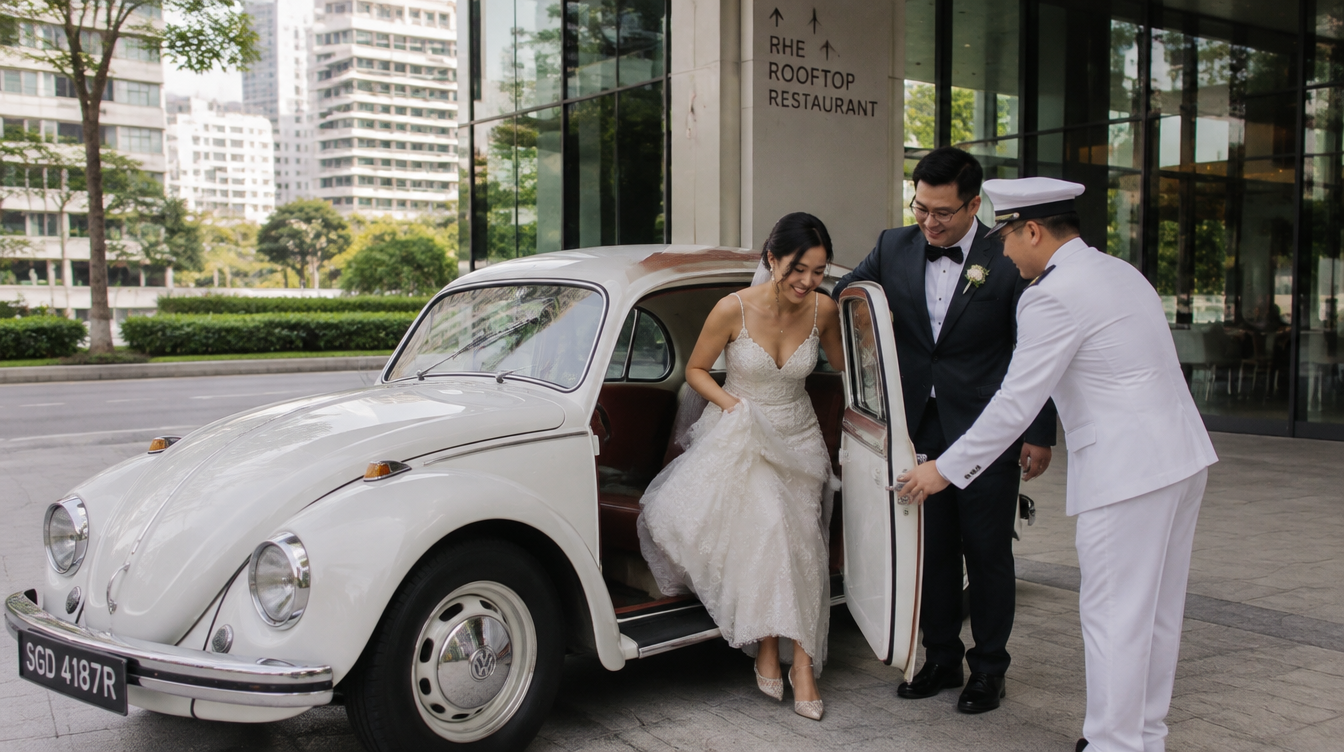
The lift doors slide open onto a rooftop bar with the whole skyline glowing behind the counter, and for a moment the bride forgets that her wedding car is parked four floors down in a loading bay built for delivery vans, not a vintage Volkswagen Beetle with a chauffeur checking his watch.
Rooftop restaurants and bars have become one of the more popular settings for a compact solemnisation or a cocktail-style reception in Singapore, prized for their view and their sense of occasion. A wedding car rooftop venue arrival asks for a different kind of planning than a hotel ballroom or a garden pavilion, mostly because almost nothing about the building was designed with a bridal car in mind. Getting the day right starts well before the car ever leaves the garage, with a few calls to the building’s management office and a clear sense of how the lift, the loading bay and the weather will each play their part. None of it is complicated on its own, but each piece tends to surface only once someone has already run into it on a previous wedding morning.
Why Lift Capacity Decides Your Timing
Most Singapore rooftop venues sit atop commercial or mixed-use buildings where the lifts were sized for office workers and restaurant patrons, not a bride in a full gown travelling with a photographer, an assistant and several guests queuing behind her. A lift that comfortably holds eight people in work clothes may fit only three once a gown, a veil and camera bags are accounted for, and during a Saturday lunch service the same lift is also carrying diners up to the restaurant floor. Weekend brunch crowds in particular can stretch a short ride into a ten-minute wait at the ground floor call button, which is rarely where a bridal party wants to be standing in full makeup.
Couples who confirm the building’s lift capacity and peak-hour patterns in advance, and who ask the venue to hold one lift briefly during the bridal party’s arrival window, generally avoid the scramble that turns a five-minute ride into a twenty-minute wait.
Loading Bays Were Not Built for a Wedding Car
Many rooftop venues share their ground floor with a loading bay meant for food deliveries and rubbish collection, governed by a time limit that building security enforces and sometimes by a boom gate that only lifts for registered vehicles. A chauffeur arriving in a vintage Kombi Bus without prior notice can find himself asked to circle the block while a delivery truck finishes unloading, which eats into the very minutes the bridal party had set aside for photographs at the entrance.
Talking to the Building Management Office Early
The building’s management office, not the restaurant itself, usually controls who gets access to the loading bay, the service lift and the visitor car park, and most ask for at least a week’s notice before they will hold any of them for a private event. Couples who have already arranged access at your condo function room for an earlier leg of the day will recognise the pattern: a building responds far better to a call made two weeks out than one made on the morning itself. The office that manages a commercial tower rarely has a wedding on its usual list of requests, so a little extra explanation of what the morning involves tends to go a long way.
A few details deserve direct confirmation with that office before the day:
- the loading bay’s exact booking window and how long a car may wait there
- whether a lift can be reserved for the bridal party’s arrival
- which entrance security will expect the chauffeur to use
- whether the venue’s own event coordinator has already filed a building access pass
- how visitor parking works for any additional cars in the convoy
Couples working with a wedding planner or the venue’s own coordinator often find this step partly done for them, but a direct call confirms nothing has slipped through between the venue and the building’s back office.
When the Sky Changes the Plan
An open-air rooftop has no covered porte-cochere to retreat to if a shower rolls in during the ten minutes the bridal party spends photographing the car, and Singapore’s afternoon downpours rarely announce themselves more than half an hour ahead. Checking NEA’s 24-hour weather forecast on the morning itself, rather than relying on a general seasonal expectation, gives the chauffeur and the venue’s indoor backup space enough warning to adjust if needed. This is especially true during the intermonsoon months, when a clear morning can turn over within the hour.
Some rooftop venues keep a small indoor function room one floor below for exactly this reason, and knowing where that fallback space sits, and how quickly the lift can move guests there, keeps a wedding morning from unravelling if the clouds do not cooperate.
Keeping the Chauffeur in the Loop
Because the car usually cannot wait directly outside a rooftop venue’s entrance the way it might at a hotel porte-cochere, most chauffeurs end up parked in a nearby lot or circling a short loop until they are called back for the departure. A short message confirming roughly when the ceremony or photographs are expected to finish spares the chauffeur from guessing, and spares the couple from reaching the lift lobby only to find the car still four minutes away.
A rooftop venue gives a Singapore wedding one of its more striking entrances, and the small amount of groundwork around lifts, loading bays and building management pays for itself the moment the car is exactly where it needs to be. The couples who enjoy that entrance most tend to be the ones who treated the building itself as part of the guest list, not an afterthought behind the restaurant’s name. If you are still weighing up venues, or want a chauffeur who already understands a building’s back-of-house routines, feel free to get in touch with our team as you start planning your own arrival.