
Ask a Peranakan bride what her wedding day actually looks like, and she probably won’t describe one ceremony. She’ll describe several: a quiet hair-combing ritual at dawn, a tea ceremony steeped in symbolism, perhaps a solemnisation squeezed in somewhere between, and only then the reception everyone else sees. Each stage has its own venue, its own guests and its own start time, which makes the simple question of how the couple actually gets from one to the next surprisingly complicated.
Singapore’s Peranakan community has kept much of this structure alive, even as modern weddings compress what was once a multi-day affair into a single, tightly scheduled Saturday. For couples planning a Peranakan wedding, especially those rooted in the shophouse streets of Katong and Joo Chiat, Peranakan wedding transport is less about one grand arrival and more about a series of smaller, well-timed ones.
A Day Built Around Many Small Ceremonies
Traditional Peranakan weddings could stretch across twelve days, each with its own rites: the chiu thau hair-combing ceremony performed the night before, the fetching of the bride, the tea ceremony where she is formally introduced to her husband’s family, and the sitting in state on an elaborately carved pelaminan. Few couples marry this way today, but many still keep two or three of these rites, folding them into one long wedding morning instead of spreading them across a fortnight.
That compression is exactly what makes the transport side tricky. A hair-combing ceremony at a grandparent’s flat in Katong, a tea ceremony at the groom’s family home and a solemnisation at the Registry of Marriages can all sit within the same three-hour window, sometimes with a costume change in between. Every one of those legs needs its own buffer, because a car that arrives five minutes late for the tea ceremony has usually already thrown off everything booked after it.
Why Katong and Joo Chiat Still Anchor the Day
Even couples who no longer live in the east often choose to hold at least one ceremony in Katong or Joo Chiat, where many Peranakan families have kept ancestral homes for generations. The area’s shophouses, gazetted for conservation by the Joo Chiat Conservation Area in 1993, remain the backdrop most closely associated with Peranakan identity in Singapore, and more than one couple has built their entire wedding-day route around being photographed in front of them.
Navigating Narrow Heritage Streets
That heritage comes with a practical cost. Streets such as Koon Seng Road and parts of Joo Chiat Road are narrow, largely one-way and lined with residents’ cars on both sides, leaving very little room for a wedding car to pull up, let alone execute a three-point turn. A chauffeur who hasn’t driven the area before can lose ten minutes just finding a spot to stop.
This is where familiarity with the neighbourhood earns its keep. Knowing which junctions allow a brief pause for the bridal party to alight, and which are too tight to attempt at all, saves a surprising amount of time on a morning where every stop is already scheduled to the minute. It also spares the couple the stress of watching their chauffeur reverse out of a dead end in full wedding dress.
Weekday mornings tend to be more forgiving than Saturdays, when the area’s cafes and boutiques draw their own crowds and street parking disappears early. Couples marrying on a weekend are generally better off building in an extra ten to fifteen minutes for the Katong and Joo Chiat legs of the day, instead of assuming the same drive time as a quieter residential estate.
Coordinating the Day’s Many Stops
Because a Peranakan wedding rarely happens in one place, it helps to map out every stop before deciding how many cars are needed and in what order they should travel. A typical modern itinerary might include:
- The bride’s family home, for the hair-combing ceremony and morning photographs
- The groom’s family home or an ancestral house in Katong, for the tea ceremony
- The Registry of Marriages or a solemniser’s venue, if legal registration falls on the same day
- A heritage street or garden for the couple’s own portraits
- The reception venue, often a hotel or restaurant across town
Tea Ceremony Timing, Peranakan Style
The tea ceremony itself deserves its own buffer, since it rarely runs to a fixed script. Elders are served in a set order, blessings and ang pow are exchanged, and a large family can easily turn a planned fifteen-minute ceremony into forty. Much like the logistics behind Chinese tea ceremony transport, the safest approach is to treat the printed schedule as a guide rather than a guarantee, and to keep the next car waiting a little longer than feels necessary.
Couples who are marrying into a Peranakan family without being Peranakan themselves often find this is the ceremony where good transport planning counts for the most, since it is usually the one stage both sides of the family attend together before splitting off to their own preparations.
A Car That Suits the Occasion
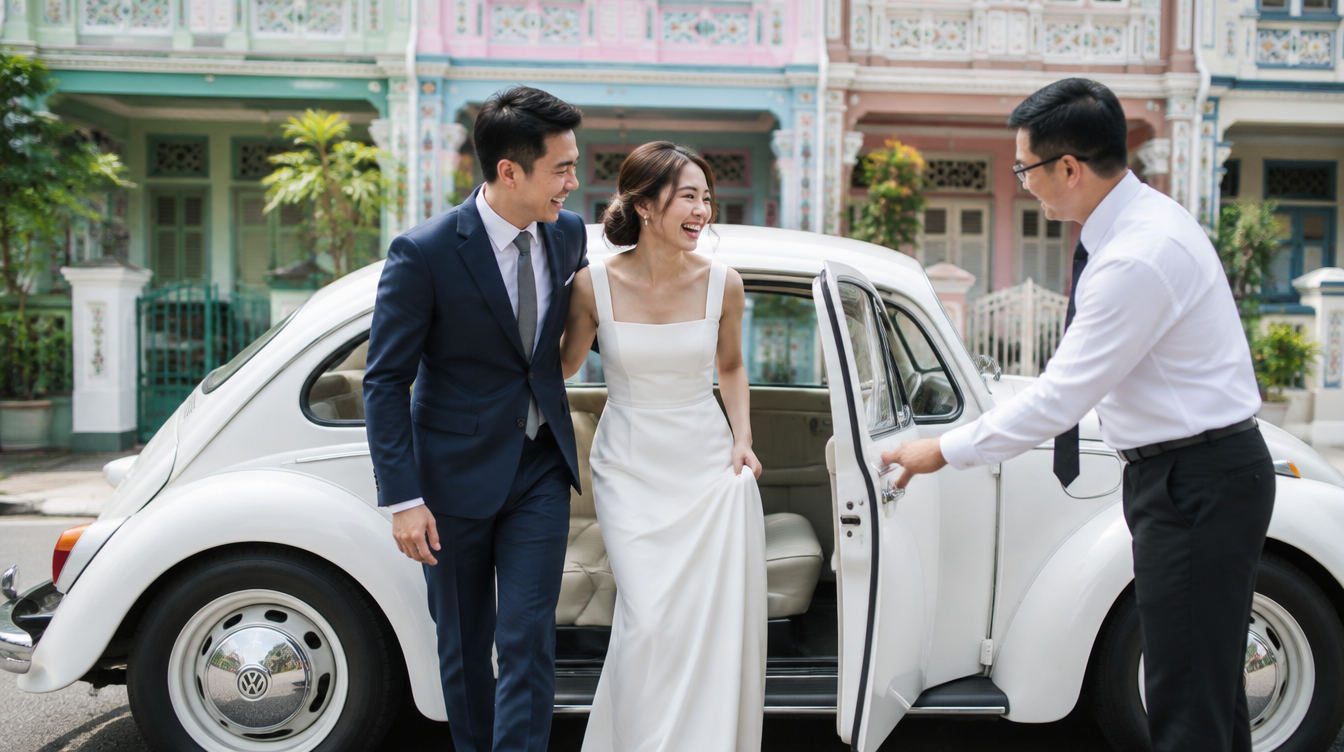
An all-white vintage Kombi Bus or Beetle tends to sit surprisingly well against Peranakan architecture, its clean, rounded lines complementing, not competing with, the ornate pastel facades behind it. Coordinating something as small as the car’s plate number for auspiciousness, a custom many Peranakan families still observe alongside their Chinese relatives, is often the finishing touch couples ask for once the bigger logistics are settled.
Bringing the Day Together
A Peranakan wedding asks a lot of whoever is behind the wheel: patience for a schedule that shifts by the hour, familiarity with streets laid out long before the car became common, and enough calm to keep a large, close-knit family moving smoothly from one ceremony to the next.
If your day moves between a family home, a temple or registry and a reception hall, it helps to plan the route with a team that has actually driven it before. To talk through timing for your own multi-stop wedding day, feel free to get in touch with WeddingCar.sg.